

The earth’s temperature is rising steadily. Eventually, rising temperatures, sea level rise and weather changes may force the world to stop global warming. By that time, global temperatures will be higher.
According to Berkeley Earth and other sources, the Earth’s average temperature is about 1.44°C (2.6°F) above the preindustrial (1850-1900) average. This increase is made up of a land temperature increase of 2.24°C (4.0°F) and the ocean temperature increase of 0.95°C (1.7°F). The ocean is a giant heat sink that absorbs about 90 percent of the heat from global warming.
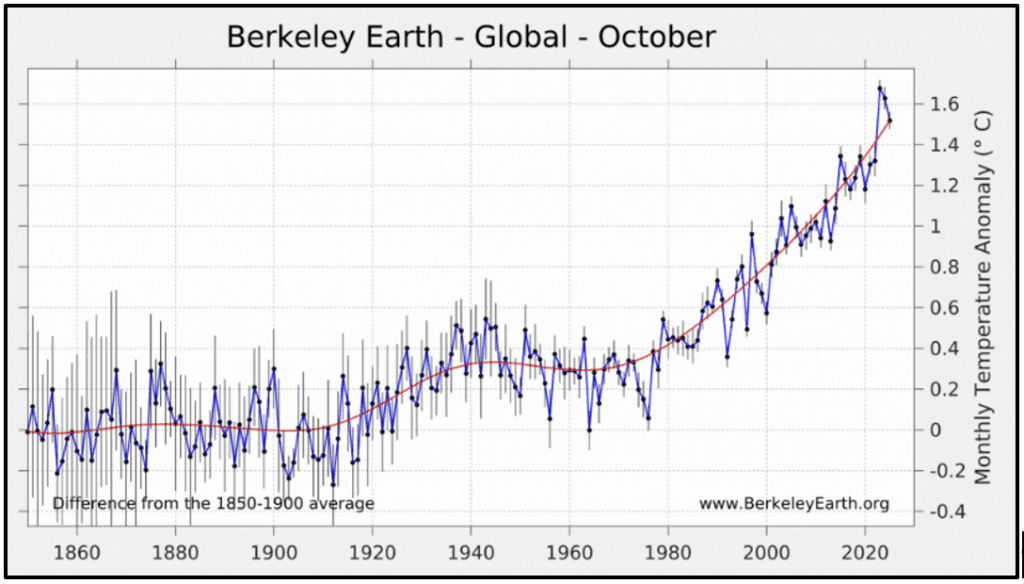
Global warming is irreversible:
Greenhouse gas emissions, mainly carbon dioxide (CO2), cause the earth to heat up. These emissions stay in the atmosphere a very long time. If we stop these emissions someday, the earth’s temperature will not go down. It will stabilize at a temperature consistent with the greenhouse gas concentrations in the atmosphere. It will take a very long time for excess greenhouse gases to be dissipated by natural means.
International goal:
The International Panel on Climate Change (IPCC) objective as stated in the 2015 Paris Agreement is to limit global temperature increases to well below 2°C compared to pre-industrial levels, but with a target of 1.5°C by 2050. It will take a few years of data to confirm if this lower limit has been permanently exceeded.
The 2°C limit is a judgement call. Beyond 2°C climate changes due to the Earth’s rising temperature risk rising more sharply with less predictable effects.
Where are we headed?
As long as the world economy depends upon fossil fuels for energy and heat, the Earth’s temperature will increase in proportion to greenhouse gases discharged into the atmosphere. These emissions increase the atmospheric concentration of carbon dioxide and other greenhouse gases, increasing the greenhouse effect.
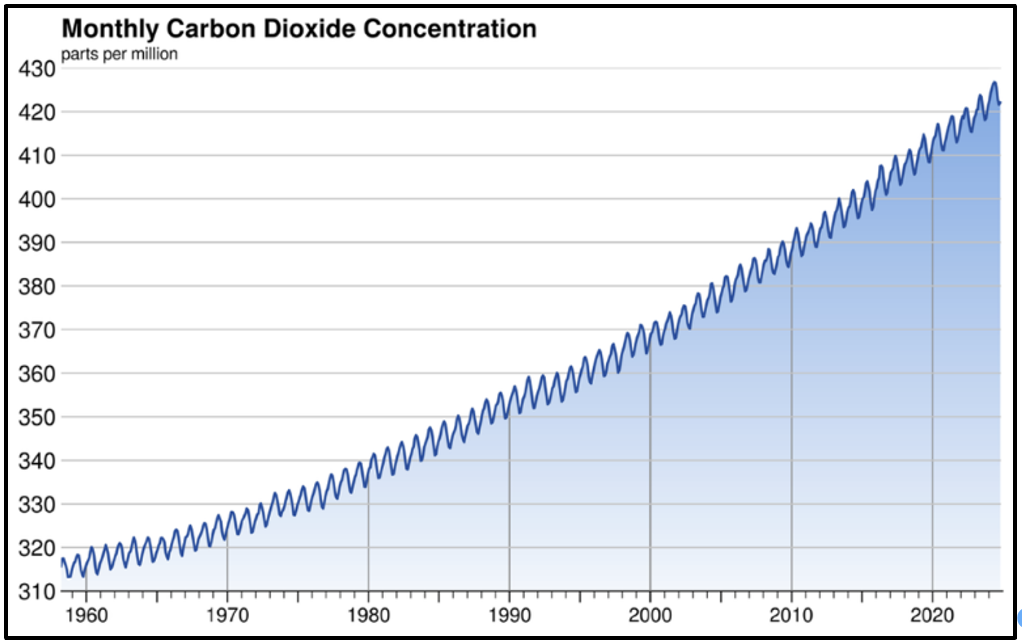
According to Climate Action Tracker, the Earth’s average temperature increase by 2100, 75 years from now, is estimated to be between 2.5°C and 2.9°C (4.5°F and 5.2°F) depending upon the actions we take.
Renewables trends:
There are some positive trends. Total global energy investment favors renewables. In 2025, total global energy investment was estimated to be $3.3 trillion. Sixty-six percent, $2.2 trillion, was invested in renewable energy (solar and wind, battery storage, nuclear, the electric grid, and electric vehicles and charging stations). Global fossil fuel investment was expected to be about $1.1 trillion in 2025, a decrease from about $1.5 trillion ten years ago.
Renewable energy, electric vehicles, and battery storage continue to have significant reductions in costs and improvements in performance that are likely to continue in the future relative to fossil fuel alternatives.
U.S. position:
The federal government is dismantling and discrediting renewable energy programs in favor of greater use of fossil fuels, attempting to grow the economy faster and to maintain energy independence based upon fossil fuels. The U.S. is the only large, developed economy with sufficient coal, oil, and natural gas reserves to achieve energy independence using fossil fuels. Others have to import a significant portion of the fossil fuels they use and have a greater incentive to use renewable energy.
Even so, there is some significant progress with renewables in the U.S. In 2025, capacity additions for electricity generation were about 63 gigawatts (GW). According to the U.S. Energy Information Agency (EIA), about 63 percent was for solar, 23 percent was for battery storage, and 13 percent was for wind, compared to 4 percent for natural gas.
China’s lead in renewables:
China and the U.S. are going in opposite directions to maintain or achieve energy independence. China’s goal is to electrify and decarbonize its energy system by 2060, when almost all its energy will come from non-fossil sources.
In 2025, China accounted for 64 percent of new global renewable energy capacity additions. Today, renewables are meeting about 84 percent of the increase in China’s electricity generation.
China is the world’s leader in renewable energy. China leads the world in the manufacture and use of solar cells, wind turbines, battery storage, electric vehicles, nuclear power, high-speed rail, and high voltage transmission systems.
An uncertain future:
Based on current trends, it is unlikely that the Earth will achieve “net zero,” no human-caused greenhouse gas emissions, in the foreseeable future. The world will have to adapt to unavoidable and unpredictable changes in the climate caused by global warming. Perhaps there will be a “wakeup call” such as a very significant warming related event that cannot be dismissed and will lead to more aggressive actions to slow or stop global warming.
China may lead the way forward if they achieve their goal to replace fossil fuels with renewables by 2060. This would lead to a 30 percent reduction in greenhouse gas emissions, China’s current share. It would also provide other countries with the products and technology needed to reduce their emissions. It would also prove that renewables are an alternative to fossil fuels.
William D. Fletcher and Craig B. Smith
William Fletcher and Craig Smith’s third book on global warming Irreversible: What Can We Do? is being released by Publish Authority in March 2026.
William Fletcher (retired) was senior vice president at Rockwell International. He served as an officer and engineer in the Navy, working on the design and operation of nuclear-powered ships, and was an engineer involved with design and construction of commercial nuclear power plants. Later, he specialized in industrial automation and international operations.
Craig B. Smith, Ph.D. (retired), is a former faculty member at UCLA. During his career, he was responsible for planning large energy conservation programs. He is the former president and chairman of the international architecture/engineering company DMJM+HN. He is the author of several books on energy efficiency and management.